
How Far Do You Go Fixing a Fix-and-Flip Before You Start Losing Money?
There's a scene that plays out in kitchens and bathrooms all across America, in houses that smell like sawdust and fresh paint and possibility. A fix-and-flip investor stands in front of a contractor, budget printout in hand, wrestling with a question that is equal parts financial and moral: How much is enough?
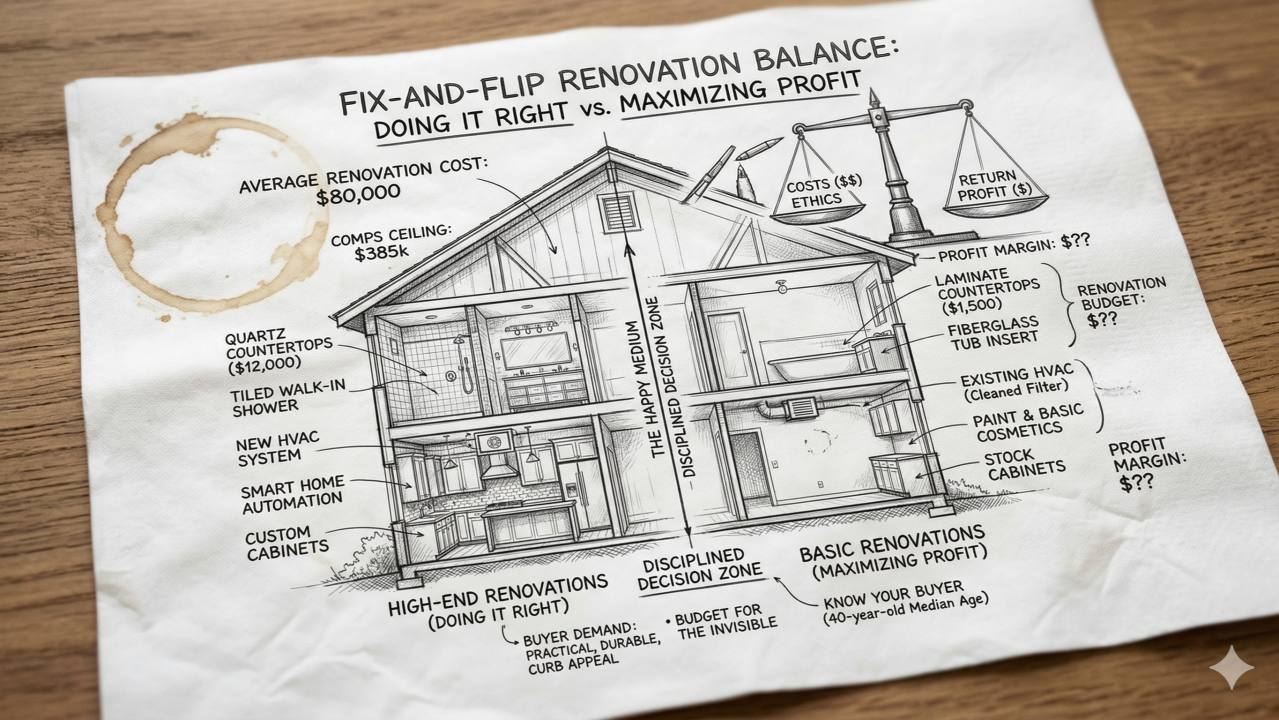
Do you put in the quartz countertops or the laminate? The fiberglass tub insert or the tiled walk-in shower? Do you replace the aging HVAC system nobody will see but everybody will feel or do you save $6,000 and hope the next owner figures it out? These aren't just business decisions. They are ethical ones. And in today's unforgiving market, getting them wrong in either direction can mean the difference between a healthy profit and a painful loss.
The fix-and-flip industry is in the middle of a reckoning. The typical flipped home in 2025 netted $65,981 in gross profit, a 25.5% return on investment, the lowest rate recorded since 2008, and a significant retreat from the 32.1% ROI reported in 2024. Flips made up just 7.4% of all home sales in 2025, slightly below the prior year, and the total number of flips, 297,045 was the lowest annual volume since 2020. The pandemic gold rush is over. The easy money has left the building. When you subtract interest on the hard money loan, taxes and insurance, material and labor for repairs and commissions, there's not much left in the profit column.
What remains is harder, leaner, and ultimately more interesting: a market that will separate the disciplined professionals from the opportunists, and force every investor to confront a question that has always lurked beneath the surface of this business. Where exactly is the happy medium between doing right by a house and doing right by your bottom line?
The Numbers Don't Lie... But They Don't Tell the Whole Story
According to Kiavi, one of the leading fix-and-flip lenders, average renovation expenses hit a record high of $80,000 in 2025, accounting for 16% of the average sales price. At the same time, borrowers faced an average interest rate of 9.8%, making financing more expensive and more difficult to obtain. And while home prices remained at record highs nationally, the percentage of homes selling below their expected after-repair value climbed to 21%, a three-year high.
That's the trap. Investors are paying more to buy, more to borrow, more to renovate and selling into a buyer pool that is more skeptical than ever. Higher mortgage rates, high home prices, and tight supply are all conspiring to squeeze investors in the home flipping play.
This is where the "over-improvement" death spiral begins. Faced with a house that needs work, an investor who doesn't know when to stop can easily turn a viable project into a monument to misplaced ambition. The $12,000 custom tile backsplash. The landscaping that rivals a boutique hotel. The smart-home automation system in a neighborhood where the comps top out at $385,000. None of it translates to sale price. All of it eats margin.
Know Your Buyer... They've Changed
Perhaps the most important shift in the fix-and-flip equation right now has nothing to do with interest rates or material costs. It has to do with who is sitting across the closing table.
The median age of first-time homebuyers has reached an all-time high of 40 years old, according to the National Association of Realtors. These are not wide-eyed millennials dazzled by subway tiles and shiplap. These are adults who have spent years renting, saving, and thinking carefully about what they actually need in a home. They are, in a word, discerning.
Today's buyers care less about ornate finishes and elaborate staging. What matters most are tasteful kitchen and bath renovations, open yard space, garage capacity, and curb appeal. Practical. Functional. Durable. And as Realtor.com senior economist Joel Berner noted, affordability concerns mean buyers are not particularly eager to pay a premium for a home where someone else has already chosen the finishings, many prefer to buy fixer-uppers and contribute their own sweat equity with renovation loans which are gaining popularity due to the affordable nature of fixer uppers and growing number of lenders offering them.
This is both sobering and clarifying. The market is telling investors exactly what it wants. The question is whether they're listening or whether they're still renovating for their own taste instead of their buyer's needs.
The Ethics of the Envelope
Here's where it gets complicated. Because "doing the right thing" in a fix-and-flip doesn't just mean staying within budget. It also means leaving behind a house that is safe, sound, and honestly represented.
The temptation, especially in a compressed-margin environment, is to cut corners on the things nobody sees. To skip the electrical update that the inspector didn't flag. To paint over the water stain rather than finding its source. To swap out the cosmetic fixtures while leaving the mechanical bones of the house untouched and aging.
This is where the dichotomy gets real. Investors are businesses, not charities. But they're also selling someone a home, often the largest purchase of that person's life. The ethical floor of fix-and-flip work isn't just a legal consideration. It's a reputational one, a moral one, and increasingly, a financial one. Buyers who feel deceived talk. Inspectors flag deferred maintenance. And a lawsuit over a failed foundation or a mold problem discovered six months after closing can erase years of profit.
The happy medium isn't about doing the minimum. It's about doing the right things, the things that genuinely add value and protect the next occupant, while deliberately skipping the things that serve only your ego or your HGTV fantasy.
A Framework for the Line
So where does the line actually fall? The answer isn't universal, but the principles are consistent among experienced operators.
Fix what's broken, skip what's merely dated. A leaking roof must be replaced. Brass cabinet pulls from 1994 do not. Structural, mechanical, and safety issues are non-negotiable. Aesthetic updates should be calibrated against comparable sales in the neighborhood not what looks good on Instagram.
Let the comps be your ceiling, not your aspiration. If the best-renovated homes in the immediate area are selling for $420,000, a $450,000 renovation budget is a fantasy. Success requires accurate forecasting of prices and renovation budgets using solid neighborhood comparable properties. Every dollar spent above what the market will pay is a dollar donated to the next buyer.
Match the upgrade to the price point. A flip in a $250,000 neighborhood should have functional, clean, and fresh not luxury. Granite counters in a starter-home market are wasted money. Conversely, cutting too many corners in a premium market signals inauthenticity and drives sophisticated buyers away.
Budget for the invisible. HVAC systems, electrical panels, plumbing, these are the unglamorous infrastructure items that buyers increasingly expect to be in working order. Leaving them in poor condition to fund the kitchen backsplash is a false economy and an ethical compromise.
Speed is profit. The average flip in 2025 took 163 days from acquisition to resale. Every additional week of carrying costs at today's financing rates chips away at margin. The best renovation is not the most beautiful one. It's the one completed on time and on budget. Flawless execution of the construction phase, with frequent checkups and quality control, is essential.
The Survivors Are the Disciplined
The savviest fix-and-flip investors see the current market not as a threat, but as an opportunity for disciplined approaches to outwit and outlast the opportunist class. The pandemic-era speculators who thrived when margins were fat are being squeezed out. What remains is a cleaner, more professional cohort of investors who understand that restraint is not a weakness but a strategy.
Signs of cautious optimism are emerging. The Kiavi Fix-and-Flip Housing Market Index recorded its largest quarter-over-quarter gain in three years at the end of 2025, reversing six consecutive quarters of decline. And nearly 90% of flippers still plan to complete a project within the next year, a striking vote of confidence from people who know the business best.
The fix-and-flip industry has always been a bet on judgment. Judgment about what to buy, where to buy it, and critically what to do with it once you own it. In a market with thin margins and sophisticated buyers, the investor who wins is the one who draws the line in exactly the right place: doing enough to command a fair price, honest enough to sleep at night, and disciplined enough to walk away from the quartz countertops.
That's the happy medium. And finding it, it turns out, is the whole game.
Access accurate remodeling budget tools and an AI Visualizer for remodeling design ideas at Ready4Remodel.com
Sources: Scotsman Guide / Matt Lavinder, New Again Houses; ATTOM 2025 Year-End U.S. Home Flipping Report; Kiavi Fix-and-Flip Market Index; CNBC / Diana Olick; Realtor.com / Joel Berner.