
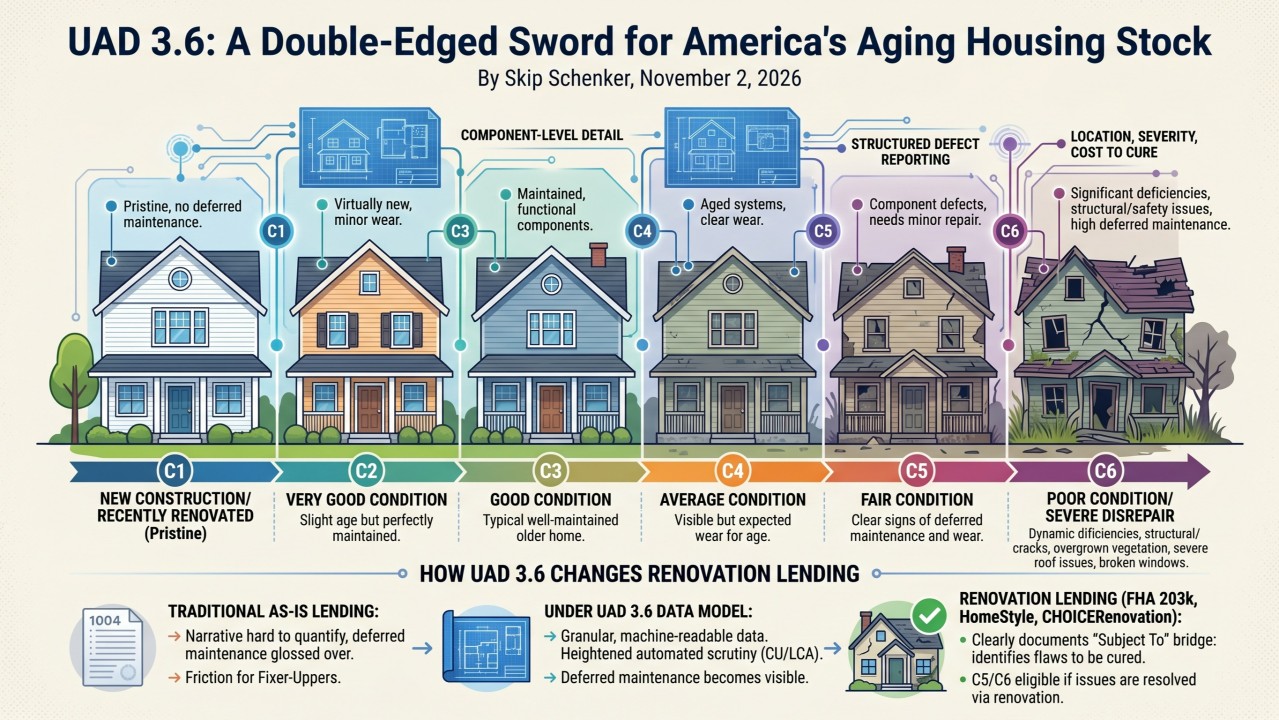
On November 2, 2026, the Uniform Appraisal Dataset moves to version 3.6, and every appraisal delivered to Fannie Mae or Freddie Mac stops using the forms the industry has relied on for decades. The 1004, 1073, 1025, 2055, 1075, and their manufactured-home, condo, and exterior-only variants are retired. In their place: a single, dynamic Uniform Residential Appraisal Report that expands or contracts based on the property, the loan type, and the scope of the assignment.
That's a technology story. The more interesting story, the one I want to make the case for here, is what this does to how the market sees older housing, and what it means for the future of renovation lending.
I'll say up front: I have a stake in this. Ready4Remodel exists because renovation financing is hard to originate well. So take this as an informed opinion, not a neutral academic exercise; but I've tried to separate what the GSEs have actually published from what's speculation, and to flag the difference where it matters.
What's actually changing
UAD 3.6 isn't a new form, it's a new data model. Instead of an appraiser filling out a template and describing the property in narrative, the report captures the property at the component level: exterior condition, interior condition, kitchens, bathrooms, flooring, individual systems, and a structured accounting of defects, damages, and deficiencies, each with a described feature, location, severity, recommended action, and estimated cost to cure.
Broad production opened January 26, 2026, giving lenders the option to start submitting in the new format. The mandatory cutover, after which legacy forms can no longer be submitted to the Uniform Collateral Data Portal, is November 2, 2026.
The condition-rating scale itself (C1 through C6) isn't new. What's new is how explicitly the appraiser has to support that rating with component-level detail, rather than a single overall impression.
The tension at the center of this
Here's my read: UAD 3.6 makes the condition of an older home far more visible and far more machine-readable than it's ever been. That cuts two ways, and I don't think the industry has fully reckoned with either side yet.
For a conventional, as-is purchase, more granular, more structured condition data probably works against some fixer-upper transactions. Deferred maintenance that used to live in a paragraph of narrative is easy to gloss over, easy to minimize, now shows up as discrete, categorized line items. An underwriter (or an automated collateral review tool) has more to react to, not less.
For a properly structured renovation loan, I think the same change is an advantage, because the appraisal is now built to answer exactly the question renovation financing needs answered: here is precisely what's wrong with the property today, here's what has to be corrected, and here's what it's worth once it is.
Whether UAD 3.6 nets out as good or bad for the renovation-lending business depends almost entirely on which of those two paths a given transaction is on and on how well-prepared the participants are.
Where the opportunity is real, not theoretical
This isn't just a narrative I'm constructing. Fannie Mae's UAD 3.6 policy supplement explicitly distinguishes minor deferred maintenance - worn flooring, minor plumbing leaks, cracked window glass, which can still be appraised as-is, from deficiencies that affect a property's safety, soundness, or structural integrity, which cannot. When a deficiency crosses that line, the appraisal must be completed "subject to" the required repairs, with the condition rating reflecting the hypothetical condition after those repairs are done.
That's not a new concept for renovation lending; it's the as-is-to-as-completed bridge that products like FHA 203(k), Fannie Mae's HomeStyle, and Freddie Mac's CHOICERenovation have always been built on. What UAD 3.6 does is give that bridge much better documentation to stand on.
Freddie Mac's own guidance is unambiguous on the practical implication: for CHOICERenovation, properties with a C5 or C6 condition rating are eligible for delivery, provided the issues that caused the rating are cured as part of the renovation and the appraisal is completed subject to that repair. That's a meaningful data point, it confirms that a bad condition rating on an older home isn't automatically a dead deal under the GSEs' own renovation products. It can be a renovation-loan deal instead.
Where I'd caution the industry not to overreact
A few things worth saying plainly, because I think they'll get lost in the enthusiasm:
Old is not the same thing as deficient. UAD 3.6's condition definitions are explicit that a well-maintained older home with some aging components can still rate C3 or C4. A 60-year-old roof isn't automatically a problem; an actively leaking one is. The risk is that inexperienced originators, appraisers, or reviewers start treating "old" as shorthand for "defective" simply because the data now makes age and wear more visible. That's a misread of the standard, not a feature of it.
C5/C6 eligibility is product-specific, not universal. Freddie Mac's general property-eligibility rule still treats C5/C6 as ineligible for standard delivery. The CHOICERenovation carve-out is exactly that, a carve-out tied to a specific program with specific cure requirements. A platform or a lender that treats "C5 is fine now" as a blanket statement, rather than a product-dependent one, is going to originate loans that don't work. This needs to be built as product-aware guidance, not a general rule of thumb.
Appraiser competency becomes the bottleneck. Renovation appraisals have always required a different skill than a standard as-is valuation. The appraiser has to reason from current condition, through a defined scope of work, to a supportable as-completed value based on renovated comparables. UAD 3.6's more structured data raises the floor on what "supported" looks like. Lenders who don't invest in renovation-experienced appraisers, and originators who don't deliver a complete, well-documented scope of work and cost estimate to the appraiser, will get worse outcomes under this standard than they did under the old one not better.
More structured data also means more automated scrutiny. UAD 3.6 is explicitly designed to feed machine-readable, standardized data into GSE review tools like Collateral Underwriter and Loan Collateral Advisor. That's a genuine double edge: the same structure that helps a renovation lender build a clean as-is/as-completed case also gives automated systems more to flag. This is still new enough that how every AMC, appraiser panel, and automated underwriting workflow interprets the new fields consistently by November 2 is a reasonable open question, and I'd treat any confident prediction about that, including some of mine here, with appropriate humility until we see a few months of production data.
My honest bottom line
I don't think UAD 3.6 is good news or bad news for the industry as a whole. I think it's a transparency shock, and transparency rewards whoever is best prepared to act on it. Traditional as-is lending on older housing stock will likely feel some friction as deferred maintenance becomes harder to gloss over. Renovation lending, if the industry does the preparation work, i.e.. better scopes of work, renovation-competent appraisers, product-specific eligibility discipline; stands to benefit from a much cleaner, better-documented path from "here's what's wrong" to "here's what it's worth once it's fixed."
The GSEs themselves have framed renovation products as a deliberate response to an aging housing supply. UAD 3.6 doesn't change that policy intent, it gives the industry a far better instrument for acting on it, if the industry uses it well.
Transform your Home... Transform your Life.
Sources: Fannie Mae UAD 3.6 Policy Supplement (Selling Guide); Fannie Mae "Available Now in Broad Production: UAD 3.6 and Forms Redesign" (Jan. 26, 2026); Fannie Mae UAD and Forms Redesign FAQs; Freddie Mac CHOICERenovation FAQ (Guide References 4607.8, 5605.5(a)(ii)8); Freddie Mac Bulletin 2025-7 and related seller/servicer guidance on C5/C6 property eligibility; McKissock Learning implementation timeline summary.