
Think about the last thing you talked yourself out of...
Odds are you didn't actually try it and decide it wasn't for you. Odds are someone told you it was too hard... a friend, a relative, a colleague who "knew a guy" and you inherited their fear without ever testing it yourself. We do this constantly. We let other people's untested opinions and fears close doors in our life.
Nowhere does this cost people more than in the decision to buy a first home.
The agent who has never done it
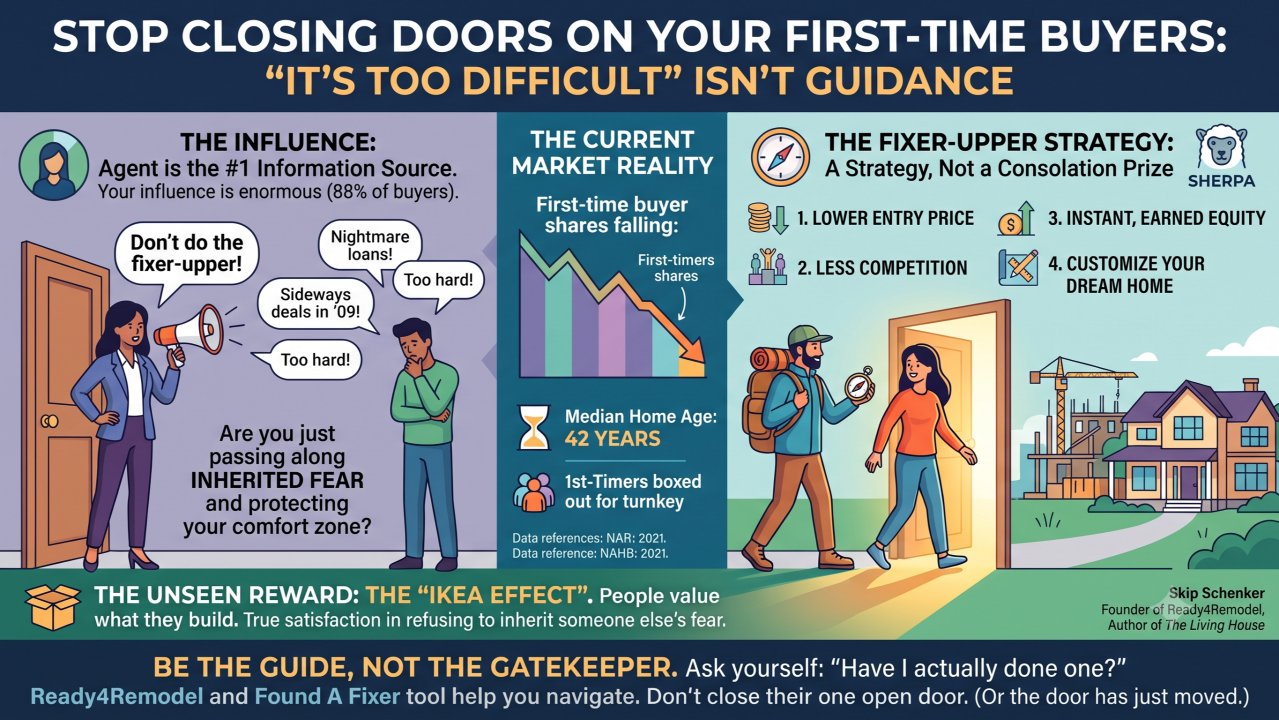
According to the National Association of REALTORS® 2025 Profile of Home Buyers and Sellers, 88% of buyers purchased through an agent or broker, and buyers ranked their agent as the single most useful information source in the entire process, ahead of every listing site. More than half of buyers said their agent pointed out problems they would have missed on their own.
That is enormous influence. It means when an agent says "don't buy the fixer-upper," most buyers don't hear a suggestion. They hear a verdict and they don't.
And I want to ask an honest question, agent to agent: Have you actually done one?
Because a lot of the "renovation loans are a nightmare" advice floating around our industry isn't based on experience. It's based on a story someone heard about a deal that went sideways in 2009, or a bad experience with a lender who didn't know the product, or the simple fact that a turnkey listing closes faster and with less work for everyone involved. That's not guidance. That's inherited difficulty, the same "it's too hard" we all absorb about a hundred other things in life.
Steering a buyer away from a renovation because you've never navigated one is not protecting them. It's protecting your own comfort zone. And it may be closing the one door that's still open to them.
Why this matters more right now than it did five years ago
Look at the market these first-time buyers are in.
The U.S. owner-occupied housing stock has never been older. The National Association of Home Builders' analysis of the latest American Community Survey puts the median age of an owner-occupied home at 42 years, up from 31 two decades ago. Roughly 47% were built before 1980; about 34% before 1970. A huge share of what's for sale needs something and much of it needs enough that a conventional buyer walks away.
At the same time, NAR reports first-time buyers fell to just 21% of the market, the lowest share since they began tracking in 1981, and down from the pre-2008 norm of around 40%. NAR describes today's market as "a tale of two cities": equity-rich repeat buyers making all-cash offers on one side, and cash-strapped first-timers getting boxed out on the other. (NAR also pegs the typical first-time buyer's age at a record 40, though mortgage-data sources like the MBA put it lower near 32, worth noting so we stay honest about the number.)
When a first-time buyer can't win the bidding war on the move-in-ready house, the fixer-upper is not the consolation prize. It is the strategy. It's the property the all-cash investor may skip because they want turnkey rentals. It's the house that scares off the buyer who has no renovation financing. Weakness in one lane is opportunity in another, but only if the buyer has a guide who knows the terrain, and a loan built for it.
The honest pros and cons
I don't advocate selling fixer-uppers as magic. Anyone who does is lying to you. The conversation a good agent should be having with their buyer instead of shutting it down.
The case for:
The case against — the real risks:
Notice something about that list. Almost every "con" is a matter of preparation and the right team, not an argument that it can't be done. "Too difficult" and "requires a guide" are not the same sentence.
The pride nobody warns them about
Now the part that never shows up in the risk column, because you can't put it on a spreadsheet.
There's a well-documented phenomenon in behavioral science called the IKEA effect, first named by researchers Norton, Mochon, and Ariely in 2011. In their studies, people valued things they built themselves far more highly than identical items made by someone else. In one experiment, subjects prized their own clumsy origami as much as the work of experts. The driver is what psychologists call effort justification and the human need to feel competent: when we pour ourselves into something and it works, we don't just own the result, we're changed by having done it.
The researchers used a telling example. A homeowner who lays a brick walkway by hand values that walkway far beyond what any buyer sees in it. That's not a flaw. That's what earned space feels like.
This is the whole argument of my book The Living House, (coming soon) explores, that a home isn't a product you consume, it's a skin you grow into. A house you rescued and rebuilt is bonded to you in a way a turnkey purchase never will be. (And yes, that same bias can lead sellers to overvalue their own improvements down the road, one more reason to have a guide who keeps the numbers honest on both ends.)
And here's the sweetest part, the part that answers the question in the title:
The pride is largest precisely when the people who love you tried to talk you out of it. The friend who said "you're crazy." The parent who warned you off. The agent who steered you toward safe and turnkey. When you stand in the finished kitchen you fought for, the one everyone told you was too hard, the satisfaction isn't just about the house. It's about having refused to inherit someone else's fear.
So what's the job?
The job isn't to be the person who tells a first-time buyer it's too difficult. That door is easy to close and impossible to un-close for that buyer.
The job is to be the guide. Nobody summits Everest by being told it's too high, they summit it with a Sherpa who has walked the route before. A buyer doesn't need to be an expert in renovation lending. They need someone standing next to them who is.
That's what we built Ready4Remodel and the Found A Fixer tool to do: turn "too difficult" into "difficult, and handled." The difficulty was never the reason to say no. It was the reason to bring the right people.
To every agent reading this, before you tell your next buyer the fixer-upper is too much, ask yourself whether you actually know that, or whether you're just passing along a difficulty you never tested yourself. Your buyer is trusting you with the biggest decision of their life. Don't close a door on their behalf that you've never once walked through.
The door has not closed. The door has just moved.
Skip Schenker is the founder of Ready4Remodel and author of The Living House, coming soon to where ever books are sold. Data sources: NAR 2025 Profile of Home Buyers and Sellers; NAHB / U.S. Census American Community Survey; Norton, Mochon & Ariely (2011) on the IKEA effect.