
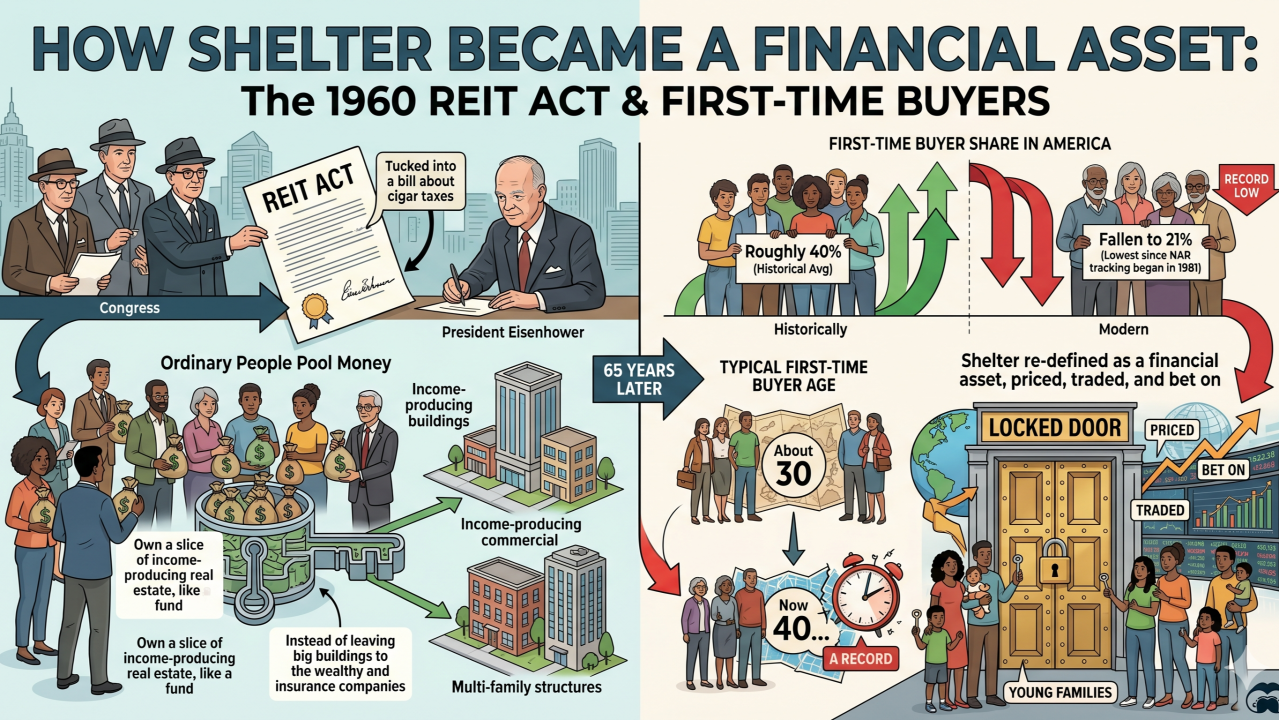
The line from Real Estate Investment Trusts and mortgage-backed securities to the worst first-time buyer market on record
In 1960, Congress did something that seemed small and technical. It passed the Real Estate Investment Trust Act, tucked into a bill about cigar taxes, and President Eisenhower signed it. The idea was almost populist: let ordinary people pool their money and own a slice of income-producing real estate the way they might own a mutual fund, instead of leaving big buildings to the wealthy and the insurance companies.
Sixty-five years later, the share of first-time home buyers in America has fallen to 21%, the lowest since the National Association of Realtors began tracking it in 1981. The typical first-time buyer is now 40 years old... a record. Historically, that buyer was about 30, and first-timers made up roughly 40% of the market.
These two facts are connected. Not by a straight line, and not as simply as the angriest takes on your feed suggest. But the story of how shelter became a financial asset something priced, traded, and bet on rather than merely lived in runs directly from that 1960 law to the locked door so many young families are standing in front of today.
Let's walk the chain.
Step one: turning a roof into a security (1960–1977)
The 1960 REIT Act created a new kind of object: a publicly traded company whose entire business was owning real estate, which paid almost no corporate tax as long as it passed 90% of its income to shareholders. For the first time, you could "own" real estate without ever touching a deed, a tenant, or a leaky pipe. Real estate became a ticker symbol.
The second piece of machinery arrived a few years later. The federal government created Ginnie Mae in 1968, converted Fannie Mae into a publicly traded company that same year, and chartered Freddie Mac in 1970. In 1970, Ginnie Mae guaranteed the first modern mortgage-backed security, a bond sold to investors, whose payments came from thousands of homeowners making their monthly payments. In 1977, the first private-label MBS followed, and a generation of Wall Street traders, led by figures like Salomon Brothers' Lewis Ranieri, built an industry on slicing and reselling American mortgages.
Here is the conceptual shift that matters: your mortgage stopped being a relationship between you and a local bank and became raw material for a financial product. The bank that lent you money no longer needed to care whether you could repay over 30 years, because it sold your loan within weeks. Risk was bundled, rated, and dispersed to investors around the world.
This was not all bad. Securitization made mortgages cheaper and more available, and helped push U.S. homeownership to historic highs. But it also did something permanent: it welded the housing market to the global capital market. From that point on, the price of a starter home in Phoenix was influenced not only by local wages and supply, but by interest rates, investor appetite, and the flow of money looking for yield.
Step two: the machine breaks, then learns to buy houses (2008–2012)
The logic of treating mortgages as securities reached its catastrophic conclusion in 2008. When loans are made to be sold rather than held, the incentive to lend carefully erodes. Subprime mortgages were packaged into bonds, rated safe, and sold globally. When they failed, they took the world economy with them.
The aftermath is the hinge of this whole story. Millions of foreclosed homes hit the market at fire-sale prices. Ordinary families had just lost their savings and their credit. But one type of buyer had cash and access to cheap financing: large investment firms. In 2012, Blackstone launched Invitation Homes and began buying single-family houses by the thousand. American Homes 4 Rent and others did the same.
A genuinely new asset class was born from the wreckage: the institutionally owned single-family rental. The house your parents bought to live in became, for Wall Street, a yield-bearing instrument, the natural extension of everything that started in 1960. Shelter was now not just financed by capital markets; it was owned by them.
Step three: the door opens, then slams (2020–2026)
For a brief window, the system seemed to deliver. When the pandemic drove mortgage rates to historic lows, 2020 became, by some measures, the strongest year on record for first-time buyers about 2.38 million of them, 40% of the market. Cheap money briefly outran high prices.
Then the door slammed. As rates climbed from under 3% toward 7% in 2022 and stayed there, two things happened at once:
The result is a market split in two. Repeat buyers, median age 62, show up with equity from past sales and pay cash nearly a third of the time. First-time buyers, with no equity and no home to sell, are simply outbid by older buyers, by all-cash offers, and at the entry-level price points in certain metros, by investors who price a house as a return on capital rather than a place to raise children.
Where did "7 million" come from?
The 7 million figure isn't a number you'll find stamped on a single government report, so let me show the arithmetic rather than assert it.
Historically, first-time buyers made up around 40% of a market of roughly 5 to 6 million existing-home sales a year. In recent years that share collapsed to 21–24%. That gap, the difference between the historical norm and the depressed reality works out to somewhere in the range of 600,000 to 1 million "missing" first-time buyers every year. Compound that across 2020 through 2026, and a cumulative shortfall on the order of 5 to 7 million households who would, in a normal market, have bought their first home and did not, is entirely defensible. Call it the lost cohort.
These aren't people who chose to wait. They are people who were priced out, outbid, or rate-locked out and who, by delaying entry roughly a decade, will lose a decade of home-equity appreciation, the single largest source of wealth for most American families.
The honest caveat, because credibility matters
If I stopped here, I'd be selling you a villain story that's too clean. Three corrections, because an argument is only as strong as the objections it survives:
Institutions own less than the headlines imply. Of roughly 14 million single-family rental homes, the large operators (1,000+ properties) own only about 3–4%. The vast majority of rental houses are still owned by small "mom-and-pop" landlords. Wall Street did not literally buy 7 million starter homes.
The bigger culprit is supply, not finance. The most important reason housing is unaffordable is that we stopped building enough of it; strangled by restrictive zoning, permitting delays, and local opposition. Financialization inflames a shortage it did not single-handedly create.
Securitization also helped people. The same machinery that enables speculation also made 30-year fixed mortgages widely available. It cuts both ways.
So the financialization of housing is not the sole cause of the crisis. But it is the change that altered the rules of the game. Before 1960, a family bidding on a home competed mostly against other families bound by local wages. After 1960 and decisively after 2012, that family competes against global capital, against investors who can pay cash, who think in basis points, and who are indifferent to whether anyone ever falls asleep under that roof.
The real lesson
The deepest consequence of treating shelter as a financial asset is not any single firm or bond. It's that the purpose of a house quietly changed. A thing that exists to be lived in behaves very differently in a market than a thing that exists to generate yield. When housing is priced as an investment, rising prices are a feature, not a problem; good news for the balance sheet, even as they wall off the next generation.
The 7 million Americans who missed their window between 2020 and 2026 are the human cost of that redefinition. Fixing it requires building far more housing and revitalizing old vacant distressed homes. But it also requires a harder conversation we've avoided for 65 years: whether a society can treat the same object as both a basic human need and a tradable financial asset.
Sources: National Association of Realtors, 2025 Profile of Home Buyers and Sellers (Nov. 2025); Zillow housing-shortage estimate (2025); Genworth First-Time Homebuyer Market Report (2020); Invitation Homes investor presentations (2024–2025); historical record of the Real Estate Investment Trust Act of 1960, Ginnie Mae (1968), Freddie Mac (1970), and the early mortgage-backed securities market. The "7 million" figure is the author's estimate of the cumulative shortfall of first-time buyers relative to historical norms, derived from NAR market-share and transaction-volume data.