
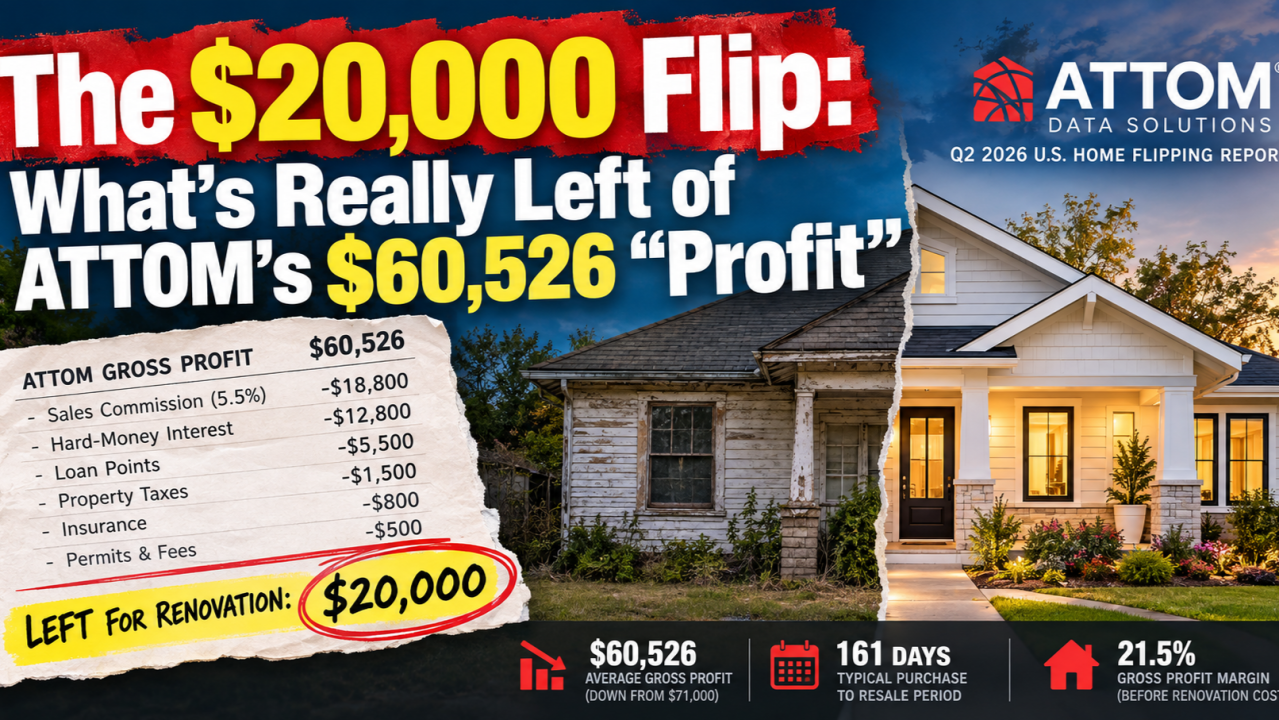
ATTOM released its Q2 2026 U.S. Home Flipping Report this week. The typical flipped home produced a 21.5% margin and a gross profit of $60,526, down from $71,000 a year ago. The headline calls it a "gradual decline."
That $60,526 isn't profit. It isn't even the renovation budget. ATTOM says so itself: the figure is just the purchase-to-resale spread, and it excludes rehab and every other expense.
So let's actually run the flip.
Operate the deal
Working backward from ATTOM's numbers, the typical flip bought at roughly $281,500 and sold at roughly $342,000 after 161 days.
Now finance it the way most flippers do: a hard-money loan covering 90% of the purchase at 11% interest and 2 points, with renovation funds released in draws as the work gets done. Here is what comes out of the $60,526 before a single contractor gets paid:
That's roughly $40,000 gone.
What's left for the actual renovation: about $20,600.
And that is the break-even number. At $20,600 of renovation, the flipper earns exactly zero. It doesn't include acquisition closing costs, title, utilities, draw inspection fees, staging, seller concessions, or the surprise behind the drywall. Change the assumptions reasonably and the range runs from about $18,000 to $23,000.
What $20,000 buys on a 42-year-old house
According to NAHB's analysis of the 2024 American Community Survey, the median owner-occupied home in America is now 42 years old, up from 31 in 2005. Nearly half were built before 1980.
NAHB's component life study puts asphalt shingle roofs at about 20 years, furnaces at 15 to 20, and water heaters at about 10. A house built in 1984 has likely outlived its original roof, furnace and water heater, whether or not anyone replaced them.
Now look at national averages from Remodeling magazine's 2025 Cost vs. Value Report:
The break-even budget doesn't cover any one of them.
What $20,000 does buy is curb appeal. A new garage door recoups 268% of its cost at resale. A steel entry door, 216%. A new roof recoups 68%.
What buyers see, pays... What the house needs, costs...
Here's where it gets interesting
The flippers themselves report spending far more than $20,000.
In the Q2 2026 Fix and Flip Market Index from John Burns Research & Consulting and Kiavi, surveyed flippers reported average renovation costs of $69,000, and 91% said they do moderate-to-heavy renovation work. One in five reported selling "mostly below" their estimated after-repair value.
Put $69,000 of renovation into ATTOM's typical deal and total costs climb to roughly $112,000, about 33% of the resale price, the very top of the range ATTOM says veterans use. Against a $60,526 spread, that's a loss of about $52,000.
Those two data sets measure different things and different samples, so they can't simply be stacked. But they can't both describe the same typical house. Either the flippers doing real renovation are buying well below ATTOM's median, or a lot of them are losing money.
The local data points in the same direction. In San Antonio, the typical flip posted a loss of 0.3% before a dollar of renovation. Dallas came in at 1.8%, Austin 2.8%, Houston 3.7%. At the bottom of the market, homes bought for $50,000 or less lost a typical $15,000. The Kiavi survey found Texas and the Southeast reporting the weakest conditions.
Who's buying these houses?
In Q2, 10.7% of flipped homes went to buyers using FHA financing, and 28.2% in Baton Rouge. The Kiavi survey found roughly half of flipped homes sold to entry-level buyers.
Many investors do thorough, honest work. I've worked alongside a lot of them for more than three decades. But when the break-even renovation budget is $20,000 and the house is 42 years old, the math rewards the visible over the necessary. And it's often a first-time buyer who inherits the difference.
Same house. Same price. Three times the renovation.
Here's the part that matters most to me.
The flip buyer pays about $342,000 and gets whatever renovation the investor's math allowed. At break-even, that's around $20,000 of work.
An owner-occupant who buys that same house as-is for about $281,500 and finances roughly $60,000 of renovation through an FHA 203(k) also ends up near $342,000. But they get about three times the renovation, and they decide whether the money goes to the furnace or the backsplash.
How? The homeowner isn't paying hard-money interest, isn't paying a commission to resell, and doesn't need a profit. That roughly $40,000 of friction becomes renovation instead.
Let me be straight about the limits. This isn't free money. A 203(k) carries its own costs, including upfront mortgage insurance, consultant fees, a contingency reserve, and closing costs. The buyer starts with very little equity. The process takes real contractor bids and a lender who knows what they're doing. And ATTOM's medians describe a typical deal, not one specific house.
But since November 2024, the Limited 203(k) allows up to $75,000 in renovation, and the Standard 203(k) handles larger and structural work. The tools exist.
The discount on America's aging homes didn't disappear when flipping margins did. It's just waiting for an owner who doesn't have to resell it.
Your turn
Investors: are your all-in costs closer to $20,000 or $69,000 of renovation, and what are you paying for capital?
Agents and lenders: when you walk into a freshly flipped 1980s house, what's the first thing you check?
First-time buyers: would you rather buy the finished kitchen, or the chance to choose what gets fixed?
I read every comment.
Transform your Home... Transform your Life.
#RealEstate #HouseFlipping #FHA203k #RenovationLending #FirstTimeHomeBuyers #Mortgage #HousingMarket #RealEstateInvesting