
Realtor.com's 2026 State Report Cards crowned a familiar set of winners. Indiana took the No. 1 spot with an A grade and a median listing price around $295,810. Iowa earned an A at roughly $282,886. South Carolina, last year's champion, held an A at about $363,896. The affordability map glows in the Midwest and South and goes dark on the coasts.
But there's a second story the price tags don't tell, one that anyone in renovation lending recognizes on sight. In most of these affordable states, the home a first-time buyer can actually afford isn't a fresh build. It's an old house. And old houses come with old systems.
How old, exactly
Start with the national baseline. The median age of U.S. housing stock reached 43 years in 2024, up from just 30 years in 2000. The typical American home was built around 1981. That aging isn't cosmetic. It's the statistical fingerprint of two decades of underbuilding, and it's showing up at the closing table: the median home purchased in 2024 was the oldest on record, and roughly 55% of homes sold that year were at least 30 years old, while only about 17% were under five years old.
Now layer the affordability map on top, and a real divide appears among the "affordable" states themselves:
That distinction matters enormously for a buyer. The first-time buyer in Indiana or Iowa isn't choosing between a $295,000 fixer and a $295,000 new build. The new build often doesn't exist at that price. The affordable option is the older home and the median first-time buyer is now 38 years old, frequently stretching every dollar of a 3.5% down payment to get in the door.
What "old" does to a house
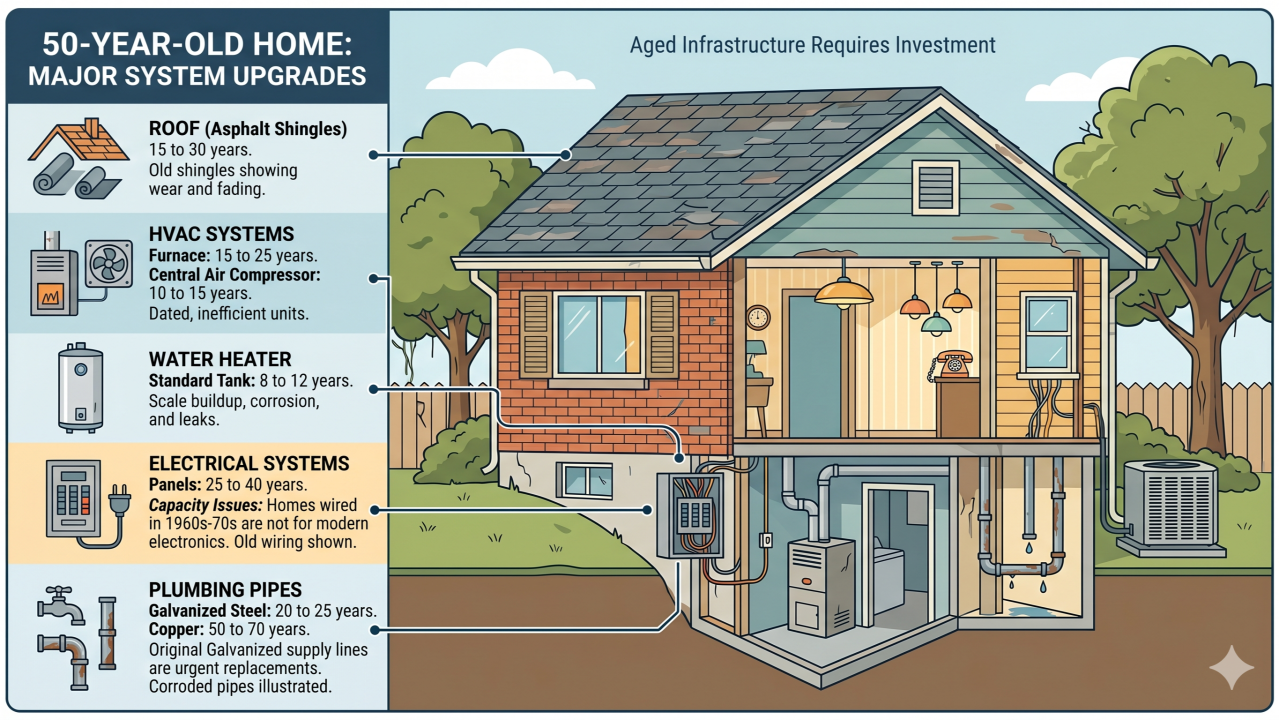
Here's the part the report card never grades: condition. A home built in 1969 is 56 years old. A home built in 1981 is 44. By those ages, nearly every major system has reached or outlived its first and sometimes second full life cycle. Walk a typical affordable older home and this is the menu a first-time buyer inherits:
The data backs up the lived experience. Homes built before 1940 are nearly 30 times more likely to be in inadequate condition and cost nearly 10 times more in routine maintenance than homes built after 2022. Even the more modest 1960s–80s affordable stock carries a steady drip of deferred-maintenance liabilities that a first-time buyer, already cash-thin after the down payment, is poorly positioned to absorb.
This is the trap. The affordable home is reachable on price and unreachable on condition. A buyer qualifies for the mortgage but can't fund the new roof, the failing furnace, and the panel upgrade on top of it. Conventional financing won't lend against a home with those defects, and the buyer doesn't have $25,000 in cash sitting behind the down payment. So the deal dies or the house goes to an investor who has both the expertise and the cash to fix it, then rents or flips it back to the very buyer who couldn't compete.
The loan built for exactly this, and almost nobody uses it
The fix has existed since 1978. The FHA's 203(k) Rehabilitation Mortgage Insurance program is, in the FDIC's own description, FHA's primary tool for the rehabilitation and repair of single-family homes. It does one elegant thing: it folds the purchase price and the renovation cost into a single, long-term, government-backed mortgage underwritten not on the home's broken-down current value but on its after-repair value, with the same 3.5% down that makes FHA lending accessible in the first place.
There are two flavors. The Limited 203(k) handles up to $75,000 of non-structural work; flooring, paint, appliances, a water heater, energy upgrades. The Standard 203(k) handles the big stuff: roofs, HVAC, plumbing, electrical, structural repair, full modernization, with a HUD consultant guiding the scope and draw schedule. Read that list again. It maps almost perfectly onto the failing-systems menu of the affordable older home.
So why is it a footnote? Because it's been treated as a niche product for decades. The loans are complex, the inspection-and-draw process is operationally heavy, and most lenders simply don't write them. The business is so concentrated that the top originators each handle just 25 to 30 loans a month, and the median rehabilitation loan has run around $183,000. Against FHA's roughly 700,000-plus annual loan endorsements, 203(k) volume is a low-single-digit sliver. The single biggest barrier, as practitioners keep saying, is that agents and buyers don't know enough about the program to feel comfortable reaching for it. A tool that solves the defining problem of the affordable-housing market sits unused because the people who need it have never had it explained.
The math, when someone does explain it, is hard to argue with. Take a $280,000 affordable older home that needs $30,000 in work... a new roof, a furnace, a panel upgrade. Instead of buying the house and then scrambling for a high-rate, short-term second loan to fix it (if a lender will even fund the purchase at all), the buyer finances $310,000 in one mortgage, puts 3.5% down on the after-repair value, and amortizes the whole thing over 30 years. The failing systems get replaced as a condition of the loan. The house re-enters the market as safe, modern, affordable family home without a single new lot being zoned or a single new foundation being poured.
Why this matters for the affordable states specifically
The 2026 report card frames the affordability fix as building more. It's not wrong, the country is millions of homes short. But new construction can't move fast enough for the markets that need help most, and it does nothing for the deep inventory of aging homes that already defines affordability across the Midwest and South.
HUD itself seems to be coming around to this. Its November 2024 enhancements to the 203(k) program were explicitly justified by the aging housing stock the agency's own language tied property renovation to preserving the quality and affordability of single-family homes as that stock gets older. That's the right instinct. The affordable house in Indiana, Iowa, Ohio, Missouri, and Kansas is, more often than not, an old house with good bones and tired systems. Renovation lending is the mechanism that turns it from a liability the average buyer can't touch into a home they can actually live in.
The supply is already standing. It just needs to be made livable and there's a 47-year-old loan program designed to do exactly that, waiting for someone to use it.
#firsttimehomebuyer, #FHA203k, #renovationloans, #renovationfinancing, #realtors, #remodeling
Sources & figures