
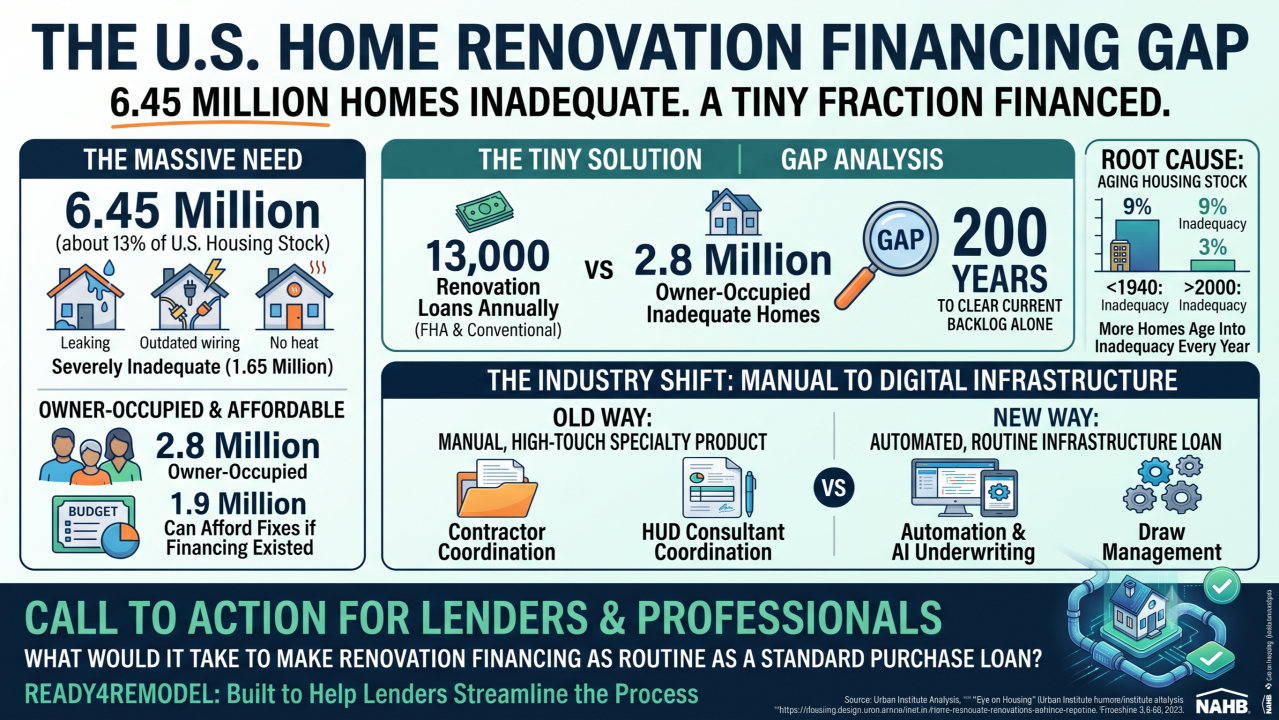
There's a number in a recent NAHB report that the renovation lending industry should sit with for a minute. In 2023, nearly 6.45 million U.S. homes - about 5% of the housing stock were classified as inadequate under HUD's standards, and 1.65 million of those were severely inadequate. Severely inadequate isn't a cosmetic label. It means exposed wiring, no electricity, no hot or cold running water, no heat, or five or more serious structural problems like large cracks and holes in the floor. These aren't investment properties. Of the roughly 2.8 million owner-occupied homes in this condition, more than half, 1.9 million - belong to owners who spend less than 30% of their income on housing, meaning most of them likely have the room in their budget to fix their homes if the financing existed to help them do it.
Now put that number next to what our industry actually does. FHA 203(k) loans closed fewer than 4,000 nationally FYE September 2024 and 2025. But the FHA 203(k) isn't the whole renovation lending market, for roughly every 203(k) loan funded, the industry closes about two conventional renovation loans through Freddie Mac's CHOICERenovation or Fannie Mae's HomeStyle programs. Add it up, and the entire industry FHA and conventional combined is closing somewhere in the neighborhood of 12,000 to 13,000 renovation loans a year. Set that next to 2.8 million owner-occupied homes classified as inadequate, and at that combined pace, financing our way through the current backlog alone, ignoring every additional home that ages into the category behind it would take roughly 200 years.
That gap isn't a housing problem. It's an industry adaptation problem.
The pattern behind these numbers is exactly what you'd expect from an aging housing stock: homes built before 1940 have the highest inadequacy rate at 9%, declining steadily to just 3% for homes built since 2000. Every year the housing stock ages without a corresponding rise in renovation financing, more homes slide into this category, and more families live with conditions that affect their health, their safety, and their basic quality of life. A parent choosing between a home with failing heat and one with exposed wiring isn't weighing preferences, they're managing risk to their family, often without knowing an affordable path out exists.
The industry that solves this doesn't need a bigger appetite for risk. FHA already insures the loan. It needs to stop treating renovation lending like a manual, high-touch specialty product and start treating it like the infrastructure problem it actually is. Draw management, contractor and HUD-consultant coordination, and renovation underwriting are exactly the kind of process-heavy, document-heavy workflows that automation and AI-assisted underwriting are suited to simplify. The tools to close that 200-year gap into something realistic already exist, what's missing is lenders building the pipeline to use them at scale.
For lenders and real estate professionals: the FHA 203(k) product isn't broken, and the borrowers aren't the friction, the origination process is. What would it take at your shop to make renovation financing as routine to originate as a standard purchase loan? Reach out, let’s discuss how Ready4Remodel was built to help lenders streamline the process.
For homeowners and first-time buyers living with a home that needs real work: if you've assumed a home in poor condition means you're stuck, or that fixing it up would take financing you don't have access to, it's worth asking a lender specifically about renovation loan options before you assume the door is closed.
The door has not closed. The door has just moved.
Source: National Association of Home Builders, Eye on Housing, "Inadequate Shelter: Millions of U.S. Homes Fail to Meet Standards," March 2025. FHA 203(k) volume figures from Urban Institute analysis of FHA origination data, 2022. Conventional-to-FHA renovation loan ratio (~2:1) per industry estimate. #